Mental Health vs. Behavioral Health: Key Differences Explained
You might have noticed the term "behavioral health" appearing more frequently lately. Perhaps you saw it on a new insurance card, a hospital sign, or while searching for a mental health screening online to understand your symptoms. It often leads to a moment of confusion: Is this different from mental health? Does it mean something else entirely?
If you are trying to navigate the healthcare system or simply understand your own well-being, these terms can feel like interchangeable jargon. However, there is a distinct difference between mental health vs behavioral health. Understanding this nuance is not just about vocabulary. It is the first step in finding the right type of support for your specific needs.
This guide will break down the definitions, provide clear examples of conditions for each, and help you decide which type of professional support might be right for you. We will clarify the confusion so you can focus on what matters most: feeling better.

Decoding the Definitions: What Do These Terms Actually Mean?
To understand the difference between mental health vs behavioral health, we need to look at what each term focuses on. While they are often used as synonyms in casual conversation, medical professionals view them through slightly different lenses.
Mental Health: Focus on Biology, Emotions, and Thoughts
Mental health is primarily concerned with your state of being. It involves your biology, your brain chemistry, and your psychological state. When we talk about mental health, we are usually referring to internal experiences:
- Your thoughts: How you perceive the world, yourself, and your future.
- Your emotions: How you regulate feelings like sadness, anger, joy, or fear.
- Your biology: The genetic and chemical factors in your brain that influence stability.
Think of mental health as the "operating system" of your mind. It dictates how you process information and experience feelings.
Behavioral Health: Focus on Actions, Habits, and Daily Impact
Behavioral health is a broader term. It looks at how your habits and daily actions impact your overall well-being—both physical and mental. It focuses on the specific choices and behaviors that affect your health.
This category includes how you cope with stress, your sleeping patterns, your eating habits, and substance use. If mental health is the operating system, behavioral health is how the user interacts with that system.
The Umbrella Effect: How Behavioral Health Encompasses Mental Health
This is where it gets a little tricky. In the modern healthcare industry, behavioral health is often used as an umbrella term.
Because your behavior (like drinking alcohol to cope) is so deeply tied to your mental state (like depression), many insurance companies and hospitals group "Mental Health" under the category of "Behavioral Health." Therefore, if you see a "Department of Behavioral Health," they almost certainly treat mental illness as well.
The Core Distinction: How They Differ in Scope
If you are still wondering how to distinguish between the two in a practical sense, it helps to look at the root causes and manifestations. The difference often lies in whether we are looking at the biology or the action.
Biology vs. Choices: A Quick Comparison Table
Here is a simple breakdown to help you visualize the behavioral vs mental health distinction:
| Feature | Mental Health | Behavioral Health |
|---|---|---|
| Primary Focus | Thoughts, feelings, and brain chemistry. | Actions, habits, and lifestyle choices. |
| Key Question | "How are you feeling and thinking?" | "What are you doing and how do you cope?" |
| Examples | Depression, Schizophrenia, Anxiety. | Substance abuse, Eating habits, Gambling. |
| Treatment | Therapy, Medication, Psychiatry. | Counseling, Rehab, Lifestyle Coaching. |
The "Hardware" vs. "User Habits" Analogy
To make it even simpler, imagine a computer.
Mental health is like the hardware and the software code. If there is a glitch in the code (chemical imbalance) or the processor overheats (trauma), the computer won't run correctly regardless of what you do.
Behavioral health is how you use the computer. Do you leave it on 24/7 without restarting (sleep deprivation)? Do you click on suspicious links that bring in viruses (substance use)? Sometimes, bad user habits can damage the hardware. Other times, faulty hardware makes it impossible to use the computer effectively.
Real-World Examples: Categorizing Common Conditions
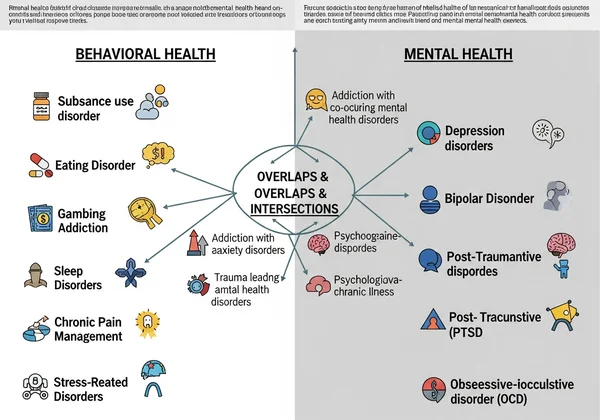
When you are trying to determine what kind of issue you might be facing, it helps to look at concrete examples. While these categories overlap, understanding the primary driver of the condition can help you "self-locate."
Typical Mental Health Disorders
These conditions are often rooted in brain chemistry, genetics, or trauma. They are primarily characterized by internal experiences rather than just outward actions.
- Generalized Anxiety Disorder (GAD): Characterized by persistent, excessive worry that is difficult to control.
- Major Depressive Disorder: A biological condition affecting mood, causing persistent sadness and loss of interest.
- Bipolar Disorder: Involves significant shifts in mood and energy levels, often linked to brain chemistry.
- Schizophrenia: Affects how a person thinks, feels, and behaves, often requiring medication for management.
Substance Use & Behavioral Habits
These issues are defined by a pattern of behavior that negatively impacts health. The symptoms are visible actions that usually serve as a coping mechanism.
- Substance Use Disorders: Using alcohol or drugs to manage emotions or stress, leading to dependency.
- Eating Disorders: Conditions like Anorexia or Bulimia often have deep mental roots but are treated behaviorally by changing eating patterns and relationship with food.
- Gambling Addiction: A compulsive behavior pattern where the "action" of gambling becomes the primary focus.
- Self-Injury: Using physical pain to cope with emotional distress. This is a behavioral symptom of deep emotional pain.
The Gray Area: Where Does ADHD Fit?
You might wonder, is ADHD mental health or behavioral health?
Attention Deficit Hyperactivity Disorder (ADHD) is a prime example of the overlap. It is a neurological condition (Mental Health) because it involves brain structure and dopamine regulation. However, it is diagnosed almost entirely by observing behaviors like fidgeting, impulsivity, or lack of focus (Behavioral Health).
Consequently, ADHD is usually managed through a combination of medication (Mental) and behavioral therapy (Behavioral) to build better habits.
Unsure Where You Stand? The Role of Self-Screening
After reading the lists above, you might feel like you fit into both categories. That is completely normal. Most people dealing with anxiety also have behavioral coping mechanisms, like overeating or insomnia.
Why Awareness is the First Step to Improvement
You do not need a formal diagnosis to start understanding your own patterns. The most important step is simply acknowledging that something feels "off." Whether it is a persistent low mood or a habit you can't seem to break, awareness is the precursor to change.
Using Educational Tools for Self-Discovery
If you are confused about your symptoms, educational tools can help clarify the picture. These are not diagnostic tools, but rather a way to check in with yourself. They can help you visualize whether your struggle is more about emotional regulation or behavioral patterns.
You can try the mental health screening tools on our platform to get a snapshot of your current well-being. These assessments are anonymous and based on standard clinical questions. They serve as a mirror, helping you see your traits more clearly so you can decide if professional support is the right next step.
The Connection: How Habits Impact the Mind
It is rarely just one or the other. Mental and behavioral health are deeply interconnected. Professionals often refer to this as "co-occurring disorders" or "comorbidity."
The Cycle: How Substance Use Affects Depression
Consider this common scenario: A person feels depressed (Mental Health). To numb the pain, they start drinking heavily every night (Behavioral Health).
Alcohol is a depressant, so the drinking actually alters their brain chemistry, making the depression worse. This leads to more drinking. This is a classic cycle where a behavioral choice exacerbates a mental health condition. Breaking this cycle often requires treating both the habit and the underlying mood disorder simultaneously.
The Physical Impact of Mental Stress
Conversely, high anxiety (Mental) can lead to physical behaviors. You might stop exercising, eat poorly, or isolate yourself from friends. These behavioral changes then degrade your physical health, leading to issues like heart disease or obesity.
Treating one usually requires treating the other. This is why the industry is moving toward "Integrated Care"—treating the whole person rather than just a set of symptoms.

Finding the Right Support: Who Should You See?
If you decide to seek help, the terminology can affect which door you knock on. However, don't let the titles scare you. Most professionals in this field are trained to look at the big picture.
Scope of Services: Medication, Therapy, and Rehab
- Behavioral Health Services: These programs focus on changing behaviors. They often include rehabilitation centers for addiction, smoking cessation programs, and cognitive-behavioral therapy (CBT) aimed at modifying specific habits.
- Mental Health Services: These services focus on the internal experience. They often include psychotherapy ("talk therapy"), psychiatric evaluation, and medication management to balance brain chemistry.
When to See a Psychiatrist or Psychologist
If your primary struggle involves mood swings, hallucinations, severe panic, or deep depression that affects your ability to function, you are likely looking for Mental Health professionals.
- Psychiatrists are medical doctors who can prescribe medication.
- Psychologists generally focus on testing and psychotherapy to uncover root causes.
When to Consult a Behavioral Health Specialist
If your primary struggle is an action you want to stop—like drinking, gambling, or angry outbursts—you might look for a Behavioral Health counselor.
- Social Workers (LCSW) and Counselors (LPC) often work in this space, using talk therapy to help you modify your behaviors and build healthier coping mechanisms.
Checklist: Questions to Ask a Potential Provider
To ensure you find the right fit, try asking these questions during your first call:
- "Do you have experience treating your specific concern, e.g., anxiety or addiction?"
- "Do you take an integrated approach to mental and behavioral health?"
- "What does a typical treatment plan look like?"
Bridging the Gap for Better Health
Ultimately, the debate of mental health vs behavioral health is mostly for insurance companies and hospitals to organize their departments. For you, the patient or the individual, the label matters less than the solution.
Your mind and your actions are parts of the same system. Whether you are struggling with a "hardware" issue like chemical imbalance or a "software" issue like a bad habit, support is available.
- Don't get hung up on the label.
- Start with your symptoms.
- Reach out to any provider—they will guide you to the right specialist if they aren't the best fit.
If you are curious about your current state but aren't ready to call a doctor, you can check your traits with this online test. It’s a safe, private way to begin your journey toward better health.
Frequently Asked Questions
Why is the term "Behavioral Health" used by insurance companies?
Insurance companies often use "Behavioral Health" because it is a broader term. It covers mental health services, addiction treatment, and marriage/family counseling under one policy benefit. It also helps reduce the stigma sometimes associated with the term "mental illness."
Is behavioral health the same as psychiatry?
No. Psychiatry is a specific medical field focused on diagnosing and treating mental illness, often with medication. Behavioral health is a wider umbrella that includes psychiatry, but also includes counseling, addiction treatment, and lifestyle management.
Self-Care vs. Professional Help: What is the role of lifestyle changes?
Lifestyle changes (like better sleep, exercise, and diet) are powerful behavioral health interventions that can improve mental health. However, for conditions like Bipolar Disorder or severe clinical depression, lifestyle changes alone are usually not enough. They work best when combined with professional treatment.
Is addiction considered a mental illness?
Yes, addiction is recognized as a disorder that affects the brain's structure and function. However, it is typically treated under the "behavioral health" umbrella because the treatment focuses heavily on changing behavior patterns and coping mechanisms.