Mental vs Emotional Health: Differences, Examples, and How They Work Together
People often use mental and emotional health as if they mean the same thing. They overlap, but they are not identical. Mental health is the broader system: how you think, focus, interpret situations, make decisions, relate to others, handle stress, and function day to day. Emotional health is more specifically about how you notice, name, express, and recover from feelings. Understanding mental vs emotional health can make self-reflection less vague. If you want a private, low-pressure starting point, a mental wellness self-check can help you organize what you have been noticing without treating the result as a formal clinical assessment.

Mental and Emotional Health Definition: The Short Version
Mental health describes the wider state of your thinking, mood, behavior, resilience, relationships, and ability to meet everyday demands. It includes emotional well-being, but it also includes cognitive patterns, attention, motivation, sleep disruption, social functioning, and the way stress affects choices.
Emotional health sits inside that larger picture. It is your capacity to recognize feelings, tolerate difficult emotions, express them in proportionate ways, and return to steadier ground after something upsetting. Someone can be emotionally aware and still be dealing with mental health strain. Someone else may be thinking clearly at work but have trouble naming anger, grief, shame, or fear.
A simple way to remember the difference is this: mental health asks, "How is my whole inner system functioning?" Emotional health asks, "How am I experiencing, expressing, and recovering from feelings?"
The two are connected in both directions. Repeated anxious thoughts can intensify fear or irritability. A painful emotion can make thinking feel foggy or extreme. Poor sleep can make both thoughts and feelings harder to regulate. A supportive routine, movement, rest, and connection can strengthen both areas over time.
Mental vs Emotional Health Differences in Everyday Life
The difference becomes easier to see when you connect each term to ordinary moments.
Mental health often shows up in thought patterns and functioning. You might notice racing thoughts, trouble concentrating, hopeless interpretations, difficulty making decisions, a change in motivation, or a feeling that small tasks require unusual effort. These experiences can affect work, school, relationships, sleep, appetite, and the ability to follow through on plans.
Emotional health often shows up in how feelings move through you. You might notice that sadness lingers for hours after a small disappointment, anger comes out sharper than intended, worry turns into avoidance, or joy feels muted even when something good happens. You may also notice the opposite: you can name what you feel, ask for space, repair after conflict, and recover after stress.
This is why mental health vs emotional health differences are useful but not rigid. A thought can trigger a feeling; a feeling can change a thought. For example, if you think "I always mess this up," you may feel shame and withdraw. If you feel overwhelmed, you may interpret neutral messages as criticism. The goal is not to label every experience perfectly. It is to create enough clarity to choose a next step.
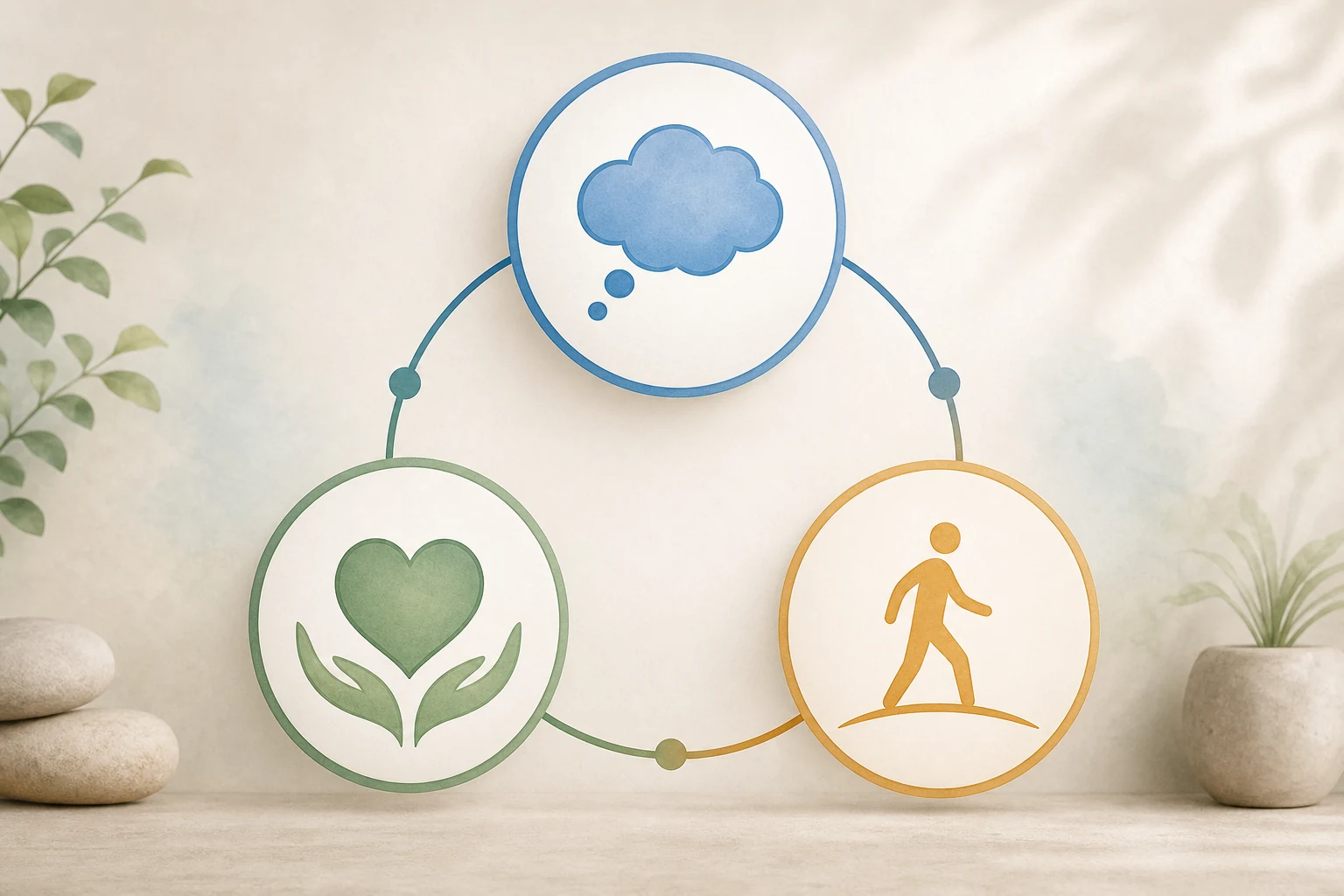
Mental and Emotional Health Examples You Might Recognize
Examples can make the distinction less abstract. Here are common patterns people may notice in themselves or someone close to them.
Mental health examples include replaying the same worry loop, struggling to focus on a simple email, interpreting many situations as personal failure, feeling mentally exhausted before the day begins, losing interest in usual routines, or finding that stress affects sleep and appetite. These examples point to the thinking, motivation, attention, and daily functioning side of the picture.
Emotional health examples include being able to say "I feel disappointed" instead of snapping, taking a pause before responding to conflict, crying after a stressful week and then feeling some relief, allowing happiness without immediately expecting it to disappear, or asking for support when emotions feel too heavy to hold alone. These examples point to emotional awareness, expression, regulation, and recovery.
Mental and emotional health examples often appear together. Imagine someone receives unexpected feedback at work. The mental side may include thoughts such as "I am not good enough" or "I will lose my chance." The emotional side may include embarrassment, fear, anger, or sadness. The behavioral side may include avoiding the next meeting or staying up late trying to overcorrect.
This is also where a structured overall mental health snapshot can be useful. It cannot replace a conversation with a qualified professional, but it can help adults organize patterns across anxiety, low mood, stress, and resilience before deciding what kind of support or reflection may help.
Mental vs Psychological Health: Where the Terms Overlap
People also search for mental vs psychological health, and the difference can be subtle. In everyday use, "mental health" is the broader public-facing term. It usually includes emotional, psychological, social, and behavioral functioning. "Psychological health" often points more directly to inner processes such as thoughts, beliefs, personality patterns, coping style, self-esteem, and adaptation.
In practical terms, you do not need to treat these as competing labels. If you are asking whether your thoughts, emotions, coping, relationships, and daily routines feel steady enough, you are already looking at a shared field. Mental health gives you the broad map. Psychological health gives you a closer look at inner patterns. Emotional health gives you a closer look at feeling awareness and regulation.
The most useful question is not "Which term is perfect?" A better question is "What is actually changing in my life?" If the change is mostly about concentration, sleep, motivation, or decision-making, mental or psychological language may fit. If the change is mostly about intense feelings, numbness, conflict reactions, or difficulty recovering after stress, emotional health may be the clearer starting point.
How to Tell If Someone Is Struggling Mentally or Emotionally
You cannot know exactly what another person is experiencing from the outside, but you can notice changes. A person may be struggling mentally if they seem unusually distracted, indecisive, withdrawn, forgetful, exhausted, pessimistic, or unable to keep up with ordinary responsibilities. A person may be struggling emotionally if their reactions seem more intense than usual, they avoid feelings, shut down during conversations, or have difficulty calming after conflict.
Look for patterns rather than a single bad day. Everyone has stressful moments. Concern rises when changes last, interfere with daily life, or feel out of character. It can also help to notice physical signs. Mental and emotional health often connect with headaches, stomach tension, sleep changes, appetite shifts, low energy, muscle tightness, or restlessness.
If you are checking in with someone, keep the conversation gentle. Try a specific observation: "You seem quieter than usual this week, and I wanted to ask how you are doing." Avoid forcing a label. Listen more than you explain. If they mention thoughts of self-harm, immediate danger, or being unable to stay safe, treat that as urgent and contact local emergency support or a crisis service.

Five Coping Strategies That Support Both Areas
The five types of coping strategies for mental health can be grouped into practical categories. They are not comprehensive care plans or replacements for support, but they can help many people build steadier routines.
First, use problem-focused coping when there is a practical step available. Break the issue into one next action, such as sending the email, asking for clarification, scheduling rest, or removing one avoidable stressor.
Second, use emotion-focused coping when the feeling needs room before the problem can be solved. Naming the feeling, breathing slowly, journaling for five minutes, or talking with a trusted person can lower the intensity enough to think more clearly.
Third, use body-based coping. Mental and emotional health can be improved through exercise for many people because movement can reduce stress tension, support sleep, and create a sense of agency. This does not require an intense routine. A walk, stretching, dancing in the kitchen, or light strength work can count.
Fourth, use connection-based coping. Isolation can make thoughts louder and feelings heavier. A short honest conversation, a support group, time with a steady friend, or professional counseling can help you test your assumptions and feel less alone.
Fifth, use meaning-based coping. This includes values, spirituality, creativity, service, learning, or any activity that reminds you your life is larger than the current stress. Meaning does not erase pain, but it can give you a wider frame for carrying it.
Why Emotional Health Matters for Mental Well-Being
Emotional health is important because feelings are information. They can tell you when a boundary has been crossed, when grief needs attention, when a relationship feels safe, or when rest is overdue. Without emotional awareness, people often respond through avoidance, overthinking, irritability, overwork, or numbness.
Emotional health also supports relationships. When you can name what you feel and communicate it with care, conflict becomes easier to repair. You may still feel angry, hurt, or anxious, but you have more options than blaming, disappearing, or pretending nothing matters.
For mental well-being, emotional health acts like a stabilizer. It helps thoughts become less extreme, decisions become less reactive, and stress become less isolating. It also makes it easier to notice when something needs more support than self-care alone can provide.
Use the Difference as a Gentle Check-In
The point of comparing mental vs emotional health is not to judge yourself more precisely. It is to understand your experience with more kindness and detail. You might ask: Are my thoughts feeling unusually heavy? Are my emotions harder to name or recover from? Are my routines, relationships, or physical signals changing? What has helped even a little?
For adults who want to organize those reflections privately, MentalHealthTest.me offers an anonymous mental health check-in that looks across anxiety, depression, stress, and resilience. Use it as an educational snapshot, not a final answer. If your results concern you, your distress is persistent, or daily life feels hard to manage, consider sharing what you notice with a qualified professional or trusted support person.

FAQ
What are 5 examples of mental and emotional health?
Five examples are clear thinking, flexible coping, emotional awareness, healthy communication, and resilience after setbacks. In daily life, that might look like concentrating on a task, naming sadness without shame, taking a pause before reacting, asking for support, and returning to routines after a stressful event.
What is the difference between mental and emotional health?
Mental health is the broader picture of thinking, mood, behavior, relationships, coping, and daily functioning. Emotional health is one part of that picture: how you notice, express, regulate, and recover from feelings. They are different, but they influence each other constantly.
How can you tell if someone is struggling mentally or emotionally?
Look for lasting changes in mood, energy, attention, sleep, appetite, social connection, reactions, or responsibilities. A single difficult day does not tell the whole story. A pattern that interferes with daily life or feels out of character deserves a gentle check-in and, when needed, professional support.
What are the 5 types of coping strategies for mental health?
Helpful categories include problem-focused coping, emotion-focused coping, body-based coping, connection-based coping, and meaning-based coping. Examples include breaking a problem into one step, naming a feeling, moving your body, talking with someone steady, and reconnecting with values or purpose.
Why is emotional health important?
Emotional health matters because feelings shape decisions, relationships, stress responses, and self-understanding. When you can recognize and work with emotions, you are more likely to respond thoughtfully instead of reacting automatically or avoiding what needs attention.
Are mental and emotional health connected to physical health?
Yes. Stress, sleep, appetite, movement, pain, energy, and tension can connect physical, mental, and emotional health. This does not mean every physical symptom has a mental cause, but it does mean whole-person patterns are worth noticing and discussing with a professional when concerns persist.